


How does Smart Water reduce the leakage of the pipe network?
The leakage of the pipe network is a difficult problem for most water companies, and it is also one of the important reasons for the high gap between the production and sales of water supply. For the loopholes hidden in the underground pipe section, in the past, it could only be checked manually one by one, which required a lot of time and manpower. Nowadays, Smart Water has given us a new way. It only needs to slightly transform the pipe network and install a high-precision smart water meter like an IoT water meter to achieve a good leakage monitoring and control effect.
Electronic remote water meter (non-magnetic/NB-IoT)
1. How does Smart Water reduce leakage?
The smart water platform provides a solution called "DMA partition metering leakage analysis", as the name suggests, is to analyze leakage through regional water supply metering. The specific implementation process is as follows:
Hierarchical division of the water supply network: divide the water supply network according to the actual situation. For example, a district in a city is set as a first-level area, and the residential area (or street) is set as a second-level area, and a community is set as a third-level area. , then the entire urban pipe network will be divided into several layers, and the water supply of each layer should theoretically be the sum of the water supply of the next layer.
Add "smart water meter": Renovate the water supply pipe network, and install high-precision intelligent remote water meters of corresponding diameters in the main pipe section of the regional pipe network at all levels to collect the total water supply in the area and upload it to the data center.
Analysis and investigation: Finally, through the smart water management platform, you can view and compare the data of the master table of each area online, you can understand the loss of tap water at all levels of the pipeline, effectively screen out the pipeline network areas with serious leakage, and arrange for manpower. Targeted repairs avoid the waste of time and manpower caused by blind leak detection, and improve the efficiency of leak control.
2. Why must a "high-precision smart water meter" be required?
In fact, the scheme of "district metering and leakage reduction" has been proposed for a long time, but it has not been implemented on a large scale in my country. There are two reasons for this: 1. The rules of my country's energy supply field are not yet perfect. There is no mandatory requirement for control, and the national water saving awareness has not been fully awakened; 2. Leakage analysis requires addition and subtraction of data from multiple meters, so the accuracy of the collected data is high, and mechanical meters were mostly used in the past. , the requirement cannot be met.
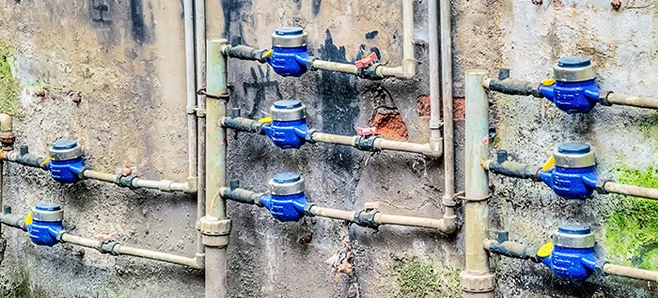
For example, the sum of the water supply volume of all households' water meters in a certain community is 14% less than the recorded data of the community's general meter. It can be inferred that there may be a large leakage of water supply pipes in this community. But in fact, all household water meters are mechanical water meters with high starting flow, and do not count the running water at small flow, so the difference of 14% is meaningless, because it is impossible to determine whether the deviation is caused by leakage or measurement error. Yes, the actual leakage may be only 5%.
Therefore, only by reducing the error of the water meter as much as possible can the zone metering achieve the desired effect. Today, there are GPRS large-diameter ultrasonic water meters in the large-diameter field, and IoT non-magnetic electronic remote-transmission water meters in the small-diameter field. They are all high-precision water meters with leading range ratios in the market. Pipeline loopholes are nowhere to be found.