


In water management, water meter reading is an essential process. It not only serves as the basis for collecting water fees but also helps water utilities monitor water usage, optimize water resource allocation, and provide data support for decision-making.
However, with the acceleration of urbanization and the increasing demand for water management, the limitations of traditional manual meter reading methods have gradually become apparent, making it difficult to meet the needs of modern management.
So, what are the shortcomings of traditional manual meter reading?
- Low Efficiency: The traditional manual meter reading method relies on meter readers to visit each household in person and record water meter data manually. This approach is not only time-consuming, but also significantly increases labor costs-especially in large-scale cities or remote areas.
- Inaccurate Data: Manual meter reading is prone to issues like omissions, misreadings, and duplicate recordings. This directly undermines the fairness and accuracy of water fee calculation and collection, and may even trigger user complaints and trust crises.
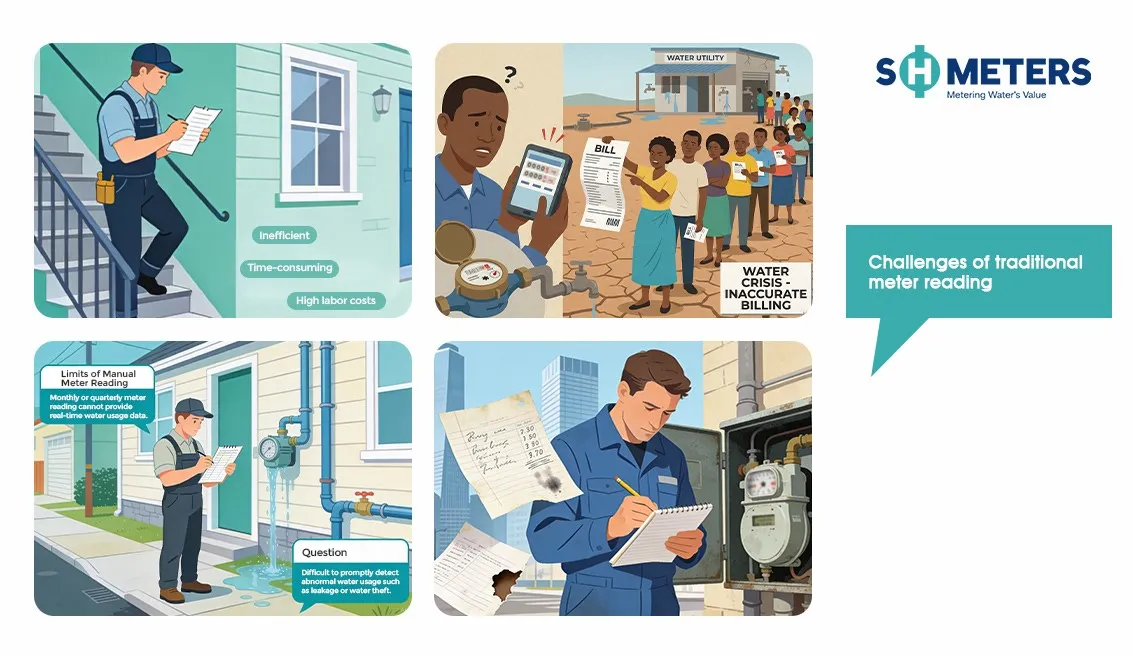
- Poor Real-Time Capability: Traditional meter reading is typically conducted on a monthly or quarterly basis, failing to provide real-time water consumption data. As a result, water utilities struggle to timely detect abnormal water usage (e.g., water leaks, water theft), leading to waste of water resources and economic losses.
- High Management Difficulty: Manually recorded meter reading data is challenging to systematically track and manage, making it susceptible to data loss, tampering, and other issues.
How does S.H. Meters' meter reading solution address these issues?
To address these challenges, S.H. Meters has developed a new meter reading solution. This system integrates advanced technologies such as Bluetooth communication, NFC identification, and image recognition processing, supporting two flexible data collection methods.
It not only significantly enhances meter reading efficiency and data accuracy but also enables real-time monitoring and management of water meters through a dedicated meter reading management platform.
1. Image recognition-based data collection:
Achieve efficient meter reading without replacing old water meters
Working principle:
The water meter reader uses an app to take a photo of a mechanical or digital meter dial. The system then uses built-in OCR (Optical Character Recognition) and AI image recognition technology to automatically capture and identify the meter reading.

Advantages:
- Cost savings: There is no need to replace or install expensive smart meters. Existing meters can be used directly, minimizing hardware investment.
- Data transparency: Each meter reading comes with the original image, allowing users or administrators to review it at any time, ensuring data reliability and transparency.
- Improved work efficiency: The recognition process is automated, reducing the time for a single meter reading from several minutes to just a few seconds, greatly enhancing the efficiency of inspection personnel.
- Offline meter reading: Data can be saved without a network connection and automatically synced to the platform once online.
- Rapid deployment: No complex network setup or device calibration is required, allowing immediate deployment across the entire area.
2.wM-Bus Data Collection
Working Principle:
Using Bluetooth scanning, the system automatically searches for nearby wMBus receivers.
When the meter reader approaches (within 100–200 meters), it can obtain real-time water meter data and convert the collected data into user-readable, structured information.

Advantages:
- Improved efficiency: Multiple meters can be read at once, significantly reducing meter reading time.
- Cost reduction: Automatic data collection minimizes manual input and operational errors, lowering labor dependency and rework costs.
- Offline data collection: With point-to-point transmission and local caching, data can be temporarily stored offline and automatically uploaded when online, allowing full-process traceability in the backend.
3.Map Function
Additionally, the APP supports a map function, which allows users to view the location, status, and regional division of all water meters. Users can quickly search for, check, and manage meter information via the map.
Advantages:
- Fast reading: The meter reader opens the app, and all meters scheduled for reading today are clearly displayed on the map. By tapping a location, the reader can quickly initiate the process of capturing photos or reading LoRa and other data, with minimal operational steps.
- Data authenticity: The app automatically records and uploads the current GPS location and timestamp during meter reading, binding them with the reading data to prevent false readings or data tampering.
- One-Click Navigation: Meter readers can navigate to target water meters based on current coordinates, with support for multiple navigation modes (driving, walking, etc.). It automatically calculates the optimal route, eliminating time waste caused by manual route searching.

- On-Site Fee Settlement: For scenarios requiring on-site fee collection (e.g., users with overdue payments), after the meter reader completes the reading in the app, the system immediately calculates the fee and prints the payment receipt. Integrated with mobile payment interfaces, users can scan the code on-site to complete the payment, with funds arriving in real-time.
- Precise fault location: When a user reports an issue, or the system automatically detects a fault (e.g., meter abnormality, communication interruption), the platform marks the fault location on the map with a prominent warning icon, showing device details and historical data.
4. Meter Reading Management Platform
S.H. Meters' meter reading solution is not just an efficient data collection tool; it also comes with a powerful management platform. Equipped with features such as regional management, map functionality, data monitoring, and remote control, it further enhances the intelligence and efficiency of water management.

- Regional Management: Administrators can group and display all water meters by regions or responsibility areas, clarifying the management scope.
- Map Function: Via the map, users can view the location, status, and regional divisions of all water meters.
- Data Monitoring: Users can access detailed water meter information, such as forward cumulative flow, water leakage, pipe burst status, and meter protocol.
- Remote Control: The platform supports remote valve control (opening and closing) for water meters.
S.H. Meters' meter reading solution, leveraging image recognition and wM-Bus data collection technologies, transforms the meter reading process from cumbersome manual operations into intelligent, automated data acquisition. This not only reduces human errors but also ensures data accuracy. At the same time, the meter management platform provides a more transparent and traceable management system, allowing water utilities to monitor meter status in real time, promptly detect leakages, reduce non-revenue water, lower operating costs, and optimize water resource allocation.
As the water industry increasingly demands intelligent and digital management, S.H. Meters' solution offers a practical upgrade path for water utilities. It supports current management needs while laying a solid foundation for sustainable development in the future.